The Ankle Decides: Five Winter Skirt Looks Where Legwear Leads

There is a moment in late fall when a skirt outfit either looks intentional or looks like you lost a fight with the weather. The difference is rarely the skirt. It is the ankle. Tights, sheers, and ribbed socks decide how heavy the hem feels, how much shoe you can carry, and whether your coat looks cropped or swallowed. Treat legwear as the main design decision and the rest of the outfit falls into line.
As of this November, the best winter skirts are not waiting for a special occasion. They are working with boots that have some tread, coats that stop at the right place, and legwear that gives the eye a clean vertical line. Below are five formulas that map legwear to skirt length, shoe volume, and coat proportion. They are starting points, not rules—but they are specific enough to remake with what you already own.
1. Sheer black + knee-length slip skirt + low loafer
This is the lightest-footed option for a gray Tuesday. A 15-to-20 denier sheer tight keeps a satin or bias-cut skirt from looking too summery, while a low-profile loafer or almond-toe flat keeps the whole look grounded. The coat should be short—a cropped wool jacket, a bomber, or a trench that hits at the hip—so the skirt hem still has room to move.
US shopping note: look for control-top sheers at Target or Nordstrom, and check the toe seam before you commit. A reinforced toe reads more everyday than a sandalfoot, especially with a loafer. If the skirt is midi, keep the shoe low and the coat short; if the skirt is just below the knee, you can add a thin sock for warmth without changing the silhouette.
2. Opaque ribbed tights + midi A-line + lug-sole boot
This is the formula for real cold. An 80-to-120 denier ribbed tight adds texture and visual weight, which means the skirt can be simpler: wool, denim, or a clean A-line in a dark solid. The lug-sole boot balances the hem, and a long coat—at least mid-calf—makes the whole thing look like a decision rather than a commute.
Keep the boot shaft close to the ankle or just above it. A chunky sole is enough volume; you do not also need a slouchy shaft. US shopping note: Uniqlo Heattech tights and Aritzia opaque tights are reliable starting points, and Madewell and Everlane usually have clean A-line skirts in fall weights. Check that the tights do not pool at the ankle—if they do, size down or choose a smoother knit.
3. Cream tights + short wool skirt + suede knee boot
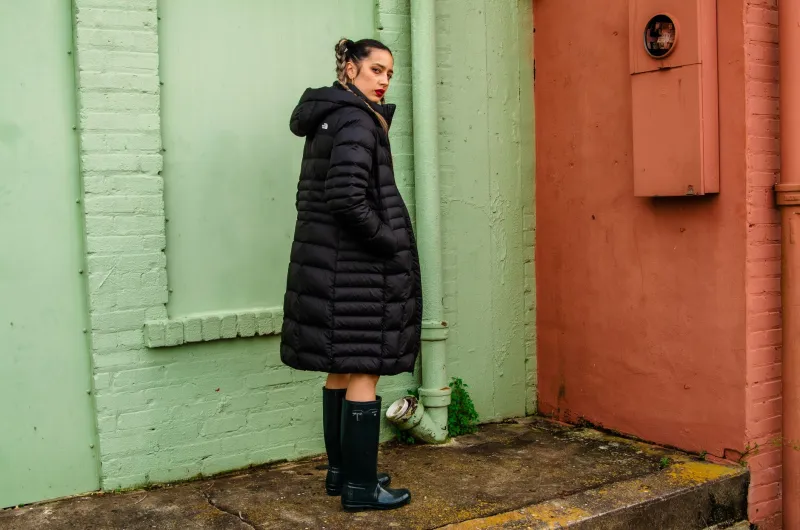
Cream or off-white tights are the fastest way to make a dark winter skirt feel styled instead of safe. Pair them with a short wool skirt—think a mini or just-above-knee A-line—and a suede knee boot in chocolate, taupe, or black. The coat should be either cropped and boxy or long and lean; a mid-length puffer that stops at the widest part of the skirt will fight the boot.
This is a high-contrast formula, so keep the rest quiet. A plain sweater, a structured bag, and one metal accent are plenty. US shopping note: cream tights show every scuff, so buy two pairs if you find a good match. COS and & Other Stories often carry off-white opaques; for boots, check Nordstrom Rack and Madewell for suede knee styles that fit close to the calf.
4. Fine patterned tight + straight midi + ballet flat
A small-scale pattern—micro-dot, fine herringbone, a faint windowpane—does the work of jewelry without adding another layer. Keep the skirt straight and simple, and choose a ballet flat or a slim mary jane with a little structure. The coat can be long and tailored, because the flat keeps the bottom half from feeling heavy.
This formula is best for offices, dinners, and days when you want to look pulled together without a heel. US shopping note: patterned tights are easiest to find at department stores and hosiery brands rather than fast-fashion racks. Look for a pattern that reads at three feet, not one inch—fine lines blur into texture, which is what you want. If the skirt has a slit, make sure the tight has enough opacity to keep the line clean when you walk.
5. Ribbed knee socks + mini skirt + chunky loafer
Knee socks are not a substitute for tights; they are a separate styling tool. A ribbed sock in charcoal, oatmeal, or navy adds a collegiate edge to a mini skirt, especially with a chunky loafer or a low boot. The coat should be short and roomy—a duffle, a cropped puffer, a boxy wool jacket—so the sock-and-skirt ratio stays visible.
Keep the sock close to the knee rather than slouched, and make sure the skirt hem clears the top of the sock by at least a hand's width. US shopping note: check the sock's rib depth and whether it stays up after twenty minutes of walking. Target, J.Crew, and Uniqlo are good places to test the idea without spending much. If you run cold, add a thin sheer tight underneath; the sock becomes the visible layer and the tight becomes insulation.
The remix test: use what you own
Before you buy anything, pull three skirts, three pairs of legwear, and three shoes onto the bed. Build one outfit from each legwear option, then stand back ten feet from a mirror. Ask three questions: Does the ankle look deliberate, or like an afterthought? Does the coat stop at a place that helps the skirt? Does the shoe feel heavy enough—or too heavy—for the tight?
Then do the walk test. Walk to the kitchen and back. If the tights twist, the socks slide, or the boot catches the hem, the formula is not working yet. Swap one element, not all three. The goal is not a new wardrobe; it is a clearer decision at the ankle. Once that reads, the skirt can be simple, the coat can be ordinary, and the outfit still looks like it was designed on purpose.