The Nightstand Is a Closing Ritual: Seven Edits for the Surface That Starts and Ends Your Day
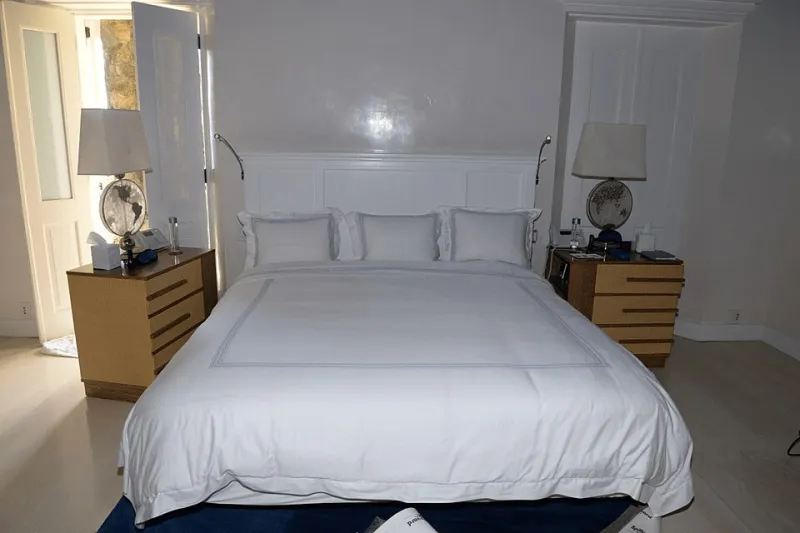
Photo: Federal Bureau of Investigation, Public domain, via Wikimedia Commons
Your nightstand has a job that has nothing to do with storage. It is the surface your room asks you to see first in the morning and last at night. That makes it one of the most influential small areas in the house—and one of the easiest to ignore. Most of us do not style a nightstand so much as let it accumulate: a water glass, a charger, a paperback, three ponytail ties, a receipt from Saturday. The result is not restful. It is just busy at eye level.
The good news is that a bedside table does not need a full redesign. It needs an edit. Think of it as a closing ritual for the room: a few deliberate moves that tell your brain the day is winding down. The goal is not a catalog-perfect vignette. It is a surface that feels calm, useful, and proportional to the bed beside it.
The Lamp Is the Anchor, Not the Afterthought
Start with scale. A too-small lamp on a generous nightstand looks like a hotel room trying its best. A too-large shade can swallow the table and crowd the pillow. As a general rule, the lamp—shade included—should occupy roughly two-thirds of the tabletop’s width without touching the edges. The bottom of the shade should land near eye level when you are sitting up in bed, so the light falls on a book rather than into your face.
Warm light matters, too. A bedside lamp is not a task light for sorting mail. It is a wind-down light. Choose a soft bulb, keep the shade opaque enough to avoid glare, and let the lamp be the visual anchor. Once the lamp is right, everything else on the table has a scale to answer to.
One Object Gets to Speak
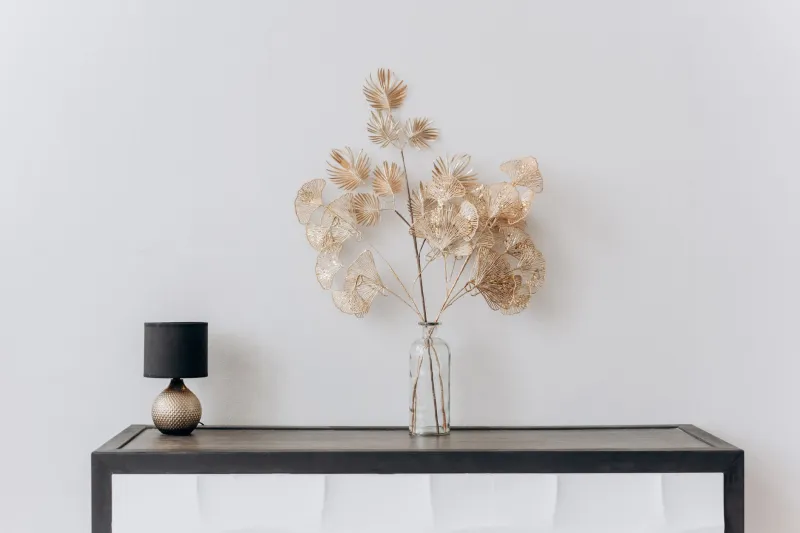
After the lamp, choose one object that earns its place. Not a collection. Not a theme. One thing with a little weight or meaning: a small ceramic dish, a framed photo, a single stem in a narrow vase, a smooth stone from a trip. This is the object that makes the nightstand feel personal rather than staged.
The key is restraint. When everything on the surface is trying to be interesting, nothing is. One meaningful object plus a good lamp already reads as designed. The rest of the table should be support staff: useful, quiet, easy to clear.
A Tray Is a Fence, Not a Decoration
A small tray or shallow dish is the most underrated tool on a nightstand. It creates a boundary. Keys, glasses, earrings, lip balm, and the charger can live inside that boundary instead of drifting across the tabletop. The tray does not magically organize your life, but it gives the clutter a container—and a container reads as intention.
Choose a tray that fits the table with room to spare. Wood, lacquer, stone, or a simple ceramic dish all work; the material should feel related to the room, not louder than it. If the tray is too large, it becomes a stage for more stuff. If it is too small, it stops being useful. Aim for something that holds the daily handful and nothing more.
Books: Edit by Weight and Repeat
A stack of books can look wonderful on a nightstand, but only if it is edited. Three or four is usually the ceiling; one or two is often better. Mix a book you are actually reading with something heavier and quieter underneath. Avoid the temptation to build a tower of decorative spines you will never open. The nightstand is not a library display.
A simple test: if you have to move a book stack to set down a glass of water, the stack is too tall or the table is too full. The surface should welcome the ordinary rituals of bedtime—phone down, glasses off, water within reach—without a small construction project.
The View From the Pillow
Proportion is easiest to judge from where you actually live. Lie down. Look at the nightstand from the pillow. Does the lamp feel balanced with the bed? Is the object visible without being crowded? Does the tray look like it belongs, or like it was dropped there? This angle matters more than the view from the doorway, because it is the one you see when you are tired.
If the table looks top-heavy, remove something. If it looks empty, increase the scale of the lamp or add one object with a little height. Small adjustments are usually enough. The nightstand does not need more; it needs better relationships between the few things on it.
The Cord Is Part of the Composition
A charging cable draped across a nightstand can undo every good decision around it. Tuck the cord behind the table, use a clip, or choose a charger that sits close to the wall. If the cable must be visible, let it be neat and intentional rather than a loose loop near the lamp base. This is not about perfection. It is about removing the one visual snag that makes the whole surface feel unfinished.
The same goes for the water glass. A simple glass or carafe is fine; a collection of half-finished cups is not. Reset the surface each morning—tray straightened, glass removed, book closed—so the room starts the day with a clean sentence rather than a run-on.
Swap One Thing, Not the Whole Room
Seasonal updates are where nightstands often go wrong. You do not need a new lamp, tray, and bedding every time the calendar turns. Change one element: a darker ceramic dish in fall, a lighter linen tray in summer, a different book, a small branch in place of a flower. This keeps the surface feeling current without turning it into a decorating project.
The nightstand is a small stage. Treat it that way. Let the lamp anchor the composition, let one object carry the personality, and let the tray absorb the daily clutter. When you turn out the light, the last thing you see should feel like a decision—not a pile. That is the quiet luxury of a well-edited bedside table: it does not ask for attention. It simply makes the room feel finished.