Open Storage, Personal Story: Nine Quiet Moves for Shelves That Feel Curated
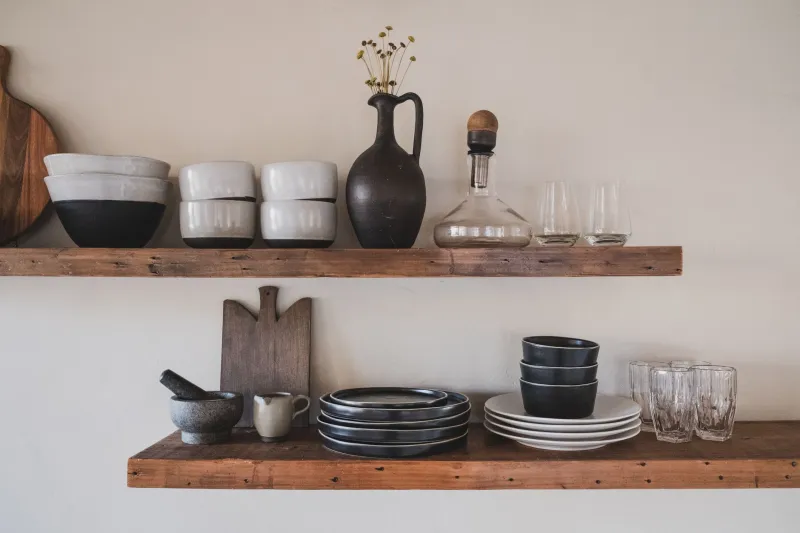
Open shelving gets a bad rap. One stray rice cooker and suddenly the whole wall reads like a lost-and-found bin. But a shelf is not a storage unit with delusions of grandeur. It is a portrait—of what you reach for, what you notice, and how you like a room to feel. In mid-November, when the light gets low and the kitchen starts hosting more than it did in summer, that portrait deserves a little editing.
The good news: you do not need a shopping trip. You need a point of view. Think of the shelf the way you think of an outfit: one anchor, a few supporting pieces, a texture or two, and enough breathing room that nothing looks forced. Here are nine quiet moves that make everyday objects look collected rather than crowded, whether the shelf is holding mugs in the kitchen or books and ceramics on a living-room ledge.
1. Cast one lead actor per shelf
Every shelf needs a lead. It can be a tall ceramic crock, a stack of bowls, a framed print, or a single wooden board propped against the wall. The lead gives the eye somewhere to land first. Without it, small objects compete for attention and the whole unit feels nervous. Pick one hero per shelf, then let everything else support it.
2. Repeat one material, not one color
Repetition is what makes a shelf feel composed. Choose one material and let it appear three times across the unit: ceramic, wood, glass, linen, or brass. The repeats do not have to match. A matte clay bowl, a glossy ceramic pitcher, and a small stoneware dish can all speak the same material language without looking like a catalog set. This is the shelf equivalent of wearing the same metal in your jewelry three times.
3. Leave a gap that looks intentional
Negative space is the difference between a display and a pile. Aim for roughly one-third empty space across each shelf. That does not mean one lonely object in the middle of a void. It means a clear pause between groups, a little air above a stack of books, a gap at the end of a row. The empty space is not wasted. It is the comma that makes the sentence readable.
4. Build small landscapes with scale
Group by scale, not by category. A tall jar, a low bowl, and a small textural object create a tiny landscape. The eye likes the variety. If everything is the same height, the shelf looks like a shelf. If everything is tiny, it looks like clutter with better lighting. Use height to create rhythm: tall, low, medium, then a pause.
5. Put useful things on show
Everyday objects are the best props because they are true. Stack the bowls you actually use. Keep the salt crock within reach. Let the cutting boards lean. A shelf that shows real life feels warmer than one styled exclusively with objects that have no job. The trick is editing the useful things down to the most beautiful examples and giving them enough space to be seen.
6. Corral the small stuff
Small objects need a container or they become visual noise. A tray, a shallow bowl, or a woven basket acts like a comma. It tells the eye: this is one group, not seven separate emergencies. Use a tray for oils and spices, a bowl for fruit, a small dish for matches or keys. Corralling also makes the 10-minute reset much faster.
7. Use books as architecture
Books are not just filler. They are structure. A horizontal stack can lift a small object and create height. A row of vertical books can anchor a shelf end. The mistake is treating books like wallpaper and filling every inch. Edit the stack to a few titles you actually like looking at, then use them as risers, bookends, or a base for a bowl. Leave the rest for another room.
8. Rotate late-fall texture without buying decor
Late fall is a texture season. You do not need new decor to mark it. Swap in what you already own: a darker ceramic, a wool runner, a wooden board, a linen cloth, dried stems from a walk, or a bowl of pears and squash. The point is not to decorate for a holiday. The point is to make the shelf feel current. One or two seasonal textures are enough. More than that and the shelf starts performing.
9. Do the 10-minute reset before guests arrive
The shelf does not need a full restyle before Thanksgiving. It needs a reset. Set a timer for 10 minutes and work in this order: clear one shelf completely, wipe it down, put back the lead actor, add one material repeat, create one deliberate gap, corral any small objects, and add one late-fall texture. Step back. If your eye stops at three places, you are done. If it stops at ten, remove something.
A good open shelf is not a museum case. It is a self-portrait with good lighting. It should look like the person who lives there knows what they like, uses what they keep, and is not afraid of an empty inch. That is the whole trick. Style the shelf like an outfit, then let it get a little lived-in. The gravy stains are not part of the plan, but the everyday objects absolutely are.